Productboard vs Outcomet: Same Problem, Different Architecture


A few months ago I sat down with a Head of Product who'd been using Productboard for two years. She'd built an impressive setup - hundreds of feedback notes tagged and linked to features, a prioritization matrix her team reviewed weekly, a roadmap her stakeholders actually looked at.
Then I asked her to trace a specific shipped feature back to the customer evidence that justified it.
She could show me the feature card. She could show me a handful of feedback notes linked to it. But the actual chain - from raw customer signal to synthesized insight to strategic decision to shipped capability - didn't exist as a connected path. It lived in her head. In meeting notes. In the space between tools.
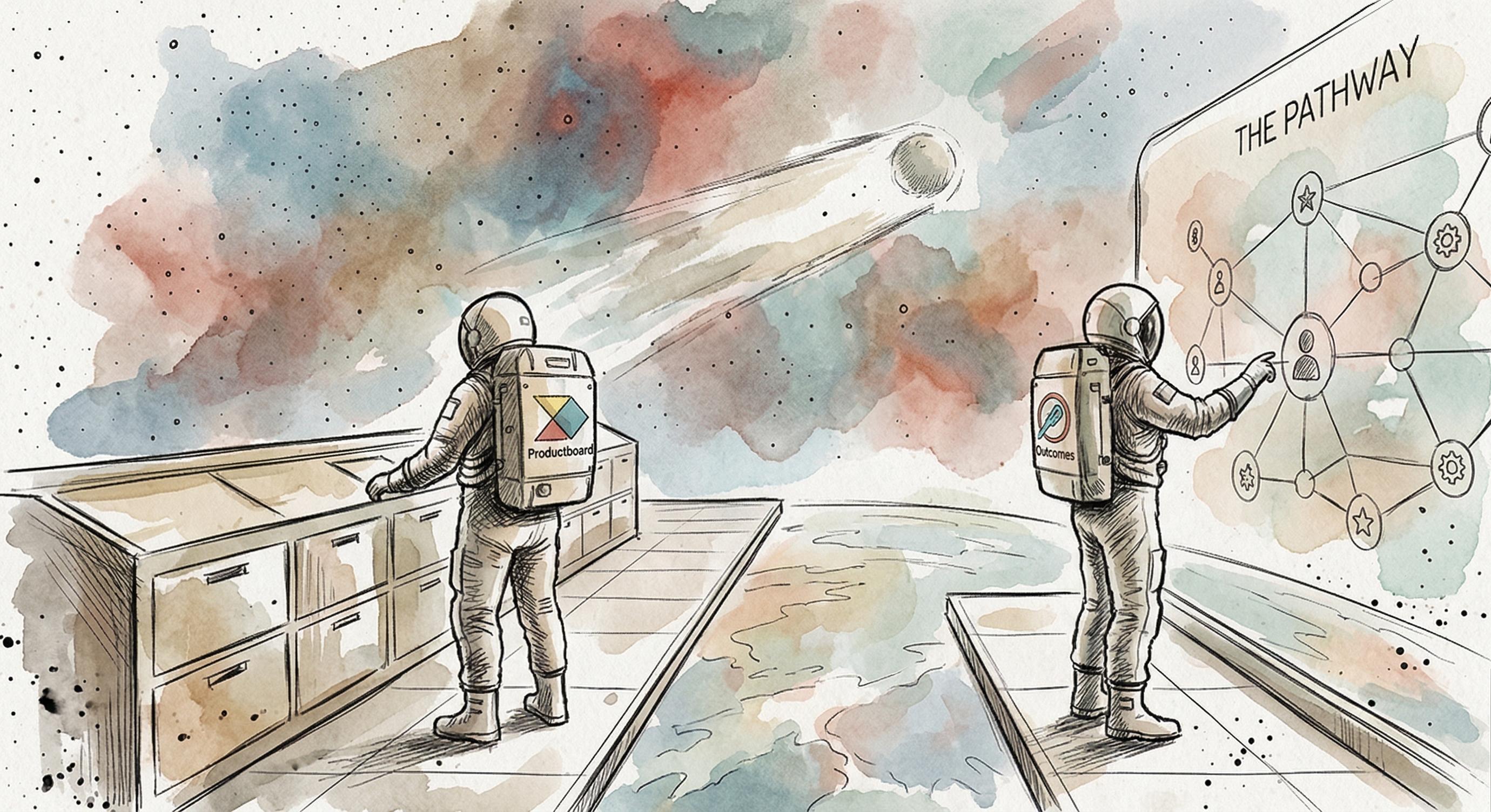
That's when I realized: Productboard and Outcomet are trying to solve the same fundamental problem, but they're built on very different assumptions about how that problem works.
At a Glance
| Productboard | Outcomet | |
|---|---|---|
| Core job | Organize feedback, prioritize features, build roadmaps | Connect customer evidence to product decisions in a learning loop |
| Best for | Structured feedback collection and feature prioritization | Evidence-driven decisions with automated insight synthesis |
| AI approach | Spark: amplifies individual PM productivity | System agents: operate on the learning loop itself |
Same problem, different architecture. Keep reading for why the approach matters more than the feature list.
What Productboard Gets Right
Productboard deserves credit for something important: it made customer feedback a first-class citizen in product management. Before tools like Productboard, most PMs managed feedback in spreadsheets, Notion pages, or - worse - not at all. Productboard brought structure to a process that had none, and it's been doing it since 2014.
The feedback collection is genuinely useful. You can pull in signals from Zendesk, Slack, Intercom, email, sales calls - all into a single Insights inbox. The ability to highlight specific parts of a user's comment and link them directly to feature ideas is elegant. It turns messy qualitative data into something you can actually navigate.
The prioritization framework is solid too. RICE scoring, custom value-vs-effort matrices, alignment with OKRs - Productboard gives teams a structured way to answer "what should we build next?" that feels more rigorous than a gut check in a planning meeting. And the roadmapping tools let you build different views for different audiences - a high-level theme-based roadmap for executives, a granular feature timeline for engineering.
Then there's Spark, their AI agent. This isn't a bolt-on chatbot. Spark can generate product briefs from rough concepts, process customer feedback at scale to surface patterns, maintain competitive intelligence, and build on institutional knowledge that persists across workflows. It has a Skills Library with 150+ AI-powered workflows. Productboard is clearly betting hard on AI - and doing it with more ambition than most incumbents.
For product teams that need to move from "feedback is everywhere and nowhere" to "feedback is organized, prioritized, and visible," Productboard is a serious tool with genuine depth.
Where the Architecture Diverges
If you step back, though, Productboard is built on an assumption that's worth examining: that product management is fundamentally about organizing and prioritizing feature ideas.
The workflow is linear. Feedback comes in. You tag it. You link it to features. You score and prioritize those features. You build a roadmap. You hand off to engineering. You ship.
Each step is well-executed. But the architecture is a pipeline - inputs flow in one direction, toward a prioritized list of things to build.
The question isn't whether you can organize feedback - it's whether organized feedback actually changes what you decide to build.
What surprised me most was how often teams with meticulously tagged Productboard setups still made roadmap decisions based on stakeholder pressure, competitive panic, or whatever felt urgent that quarter. The feedback was there - organized, scored, linked to features - but it wasn't structurally connected to the decision-making process. It was evidence sitting in a library that nobody cited when the actual roadmap conversation happened.
The deeper issue is philosophical. Productboard treats product management as a prioritization problem: you have a pool of feature ideas, you need to pick the best ones, you need to show stakeholders why. The system is designed to make that selection process more rigorous.
But product strategy isn't really a prioritization problem. It's a learning problem. The question isn't "which feature should we build next?" - it's "what are we learning from our customers, and how should that reshape what we believe about our product?"
That distinction sounds subtle. In practice, it changes everything about how a system needs to work.
What Happens When Organization Isn't Enough
Here's where I noticed the pattern breaking down. A PM using Productboard receives a cluster of feedback about onboarding friction. She tags each note, links them to a "Simplify onboarding" feature idea, scores it. The feature sits in the backlog, ranked against fifty other scored features.
Three months later, the team ships a different feature - one that scored higher on the impact matrix. The onboarding feedback is still there, neatly organized, waiting. But the customers who provided it have already churned.
The system preserved the feedback perfectly. What it didn't do was surface the urgency of the emerging pattern, connect it to churn data that was sitting in a different tool, or challenge the PM's existing prioritization model. The feedback was organized. The insight was missing.
This is the structural gap. Productboard (even with Spark) is designed as what they call a "system of work" for product managers - a place where a PM thinks, plans, and executes. The intelligence is centered on making the PM more productive. It generates briefs, summarizes feedback, builds competitive battle cards. Powerful capabilities, all in service of helping an individual PM work faster.
But the hardest problems in product management aren't about individual PM productivity. They're about organizational learning. Can the product team, as a system, learn faster from customers than the market is changing? Can a decision made today be traced back to evidence six months from now? Can a pattern that emerges across three different customer segments be surfaced before any single PM would notice it?
A Different Model for the Same Problem
Outcomet starts from a different assumption: that the core job of a product operating system isn't to help PMs organize features - it's to close the loop between customer evidence and product decisions, continuously, as a system.
Instead of a linear pipeline from feedback to roadmap, Outcomet runs a continuous cycle:
- Signals flow in - customer feedback, usage data, market reactions
- Discovery happens automatically: AI agents cluster unstructured feedback into themes, deduplicate noisy signals, flag emerging trends
- Strategy gets validated, decisions are connected to the evidence that supports them
- Capabilities ship, and generate new signals that feed back into the system
The difference from Productboard's architecture isn't about which tool has better AI. It's about what the AI is for.
In Productboard, Spark helps the PM work faster within a pipeline, generate a brief faster, summarize feedback faster, build a competitive card faster. The intelligence amplifies the individual.
In Outcomet, the AI agents operate on the system itself. The Research Agent doesn't just summarize an interview - it processes it into structured signals that automatically connect to existing themes. The Theme Synthesizer doesn't wait for a PM to notice a pattern, it continuously clusters incoming feedback and surfaces trends the moment they emerge. The Strategy Mapper doesn't generate a document, it validates whether shipped capabilities actually address the customer evidence they were meant to address.
The result is traceability that exists because the system built it, not because a PM maintained it. You can look at any shipped capability and trace it back through the strategic decision, through the synthesized theme, all the way to the individual customer signals that shaped it. That chain isn't reconstructed after the fact - it's the natural output of how the system works.
How They Actually Compare
| Productboard | Outcomet | |
|---|---|---|
| Core job | Organize feedback, prioritize features, build roadmaps | Connect customer evidence to product decisions in a learning loop |
| Primary unit | Features, feedback notes, objectives | Signals, themes, capabilities, decisions |
| Architecture | Linear pipeline: feedback → prioritization → roadmap | Continuous loop: signals → discovery → strategy → capabilities → signals |
| AI philosophy | Amplify the individual PM (Spark: briefs, summaries, competitive cards) | Operate on the system (agents that cluster, synthesize, validate) |
| Feedback handling | Manual tagging + AI-assisted summarization | Automated clustering, deduplication, and trend detection |
| Decision traceability | Feedback linked to features, but chain breaks at the decision layer | Full traceability from signal to theme to decision to shipped capability |
| Insight surfacing | PM-driven: you find patterns by reviewing tagged feedback | System-driven: patterns surface automatically as feedback accumulates |
| Best for | Teams that need structured feedback collection and feature prioritization | Teams that need evidence-driven decisions with automated insight synthesis |
Which One Fits Your Team
If your team's primary challenge is getting feedback organized, moving from chaos to structure, building a visible roadmap for stakeholders, running a prioritization process that feels more rigorous than "the CEO said so", Productboard handles that well. It's mature, well-integrated with Jira and Slack and Zendesk, and teams can be productive in it quickly. Spark genuinely makes individual PMs faster at the document-heavy parts of the job.
The tradeoffs are worth knowing. The learning curve is real - teams report weeks to months before they feel fluent. The per-maker pricing with the AI add-on adds up fast for larger teams. And the feature hierarchy gets rigid once you've committed to a structure - changing your mind about how products and features relate to each other is harder than it should be.
If your challenge has moved past organization into insight - you have plenty of feedback but struggle to synthesize it into patterns, you make decisions that are hard to trace back to evidence, you want AI to do the structural work of learning so your PMs can focus on strategic judgment - that's where Outcomet's architecture matters.
The distinction maps roughly to what your team is bottlenecked on. If the bottleneck is "we don't have a system for managing feedback and features," Productboard removes it. If the bottleneck is "we have a system, but it doesn't actually change how we make decisions," that's a different kind of problem, one that requires a different architecture to solve.
The Shift from Organizing to Learning
The comparison between Productboard and Outcomet reflects a broader shift happening in product management tooling. The first generation of PM tools digitized existing processes, they turned sticky notes into cards, spreadsheets into prioritization matrices, and email threads into feedback portals. They made the old workflow faster and more visible. Productboard is arguably the best execution of that generation.
The next generation is asking a different question: what if the workflow itself is incomplete? What if the bottleneck in product management was never "we can't organize our feedback" but "we can't learn fast enough from our customers to make decisions that hold up"?
Both Productboard and Outcomet have bet heavily on AI. The difference is what they pointed the AI at. One uses it to make PMs faster at their existing workflow. The other uses it to create a workflow that didn't exist before - one where the system itself learns, and every decision leaves a traceable evidence trail.
Building the right product was never a prioritization problem. It was always a learning problem. The tools are finally starting to diverge on which problem they think they're solving.
Related Posts


Linear vs Outcomet: Two Tools Heading in the Same Direction
Linear is expanding from issue tracking into an agent-driven development platform. Outcomet started in strategy and discovery. Both are converging, but from opposite directions. Here's why that matters for your product team.


Death by Approval Clicks
Modern AI coding workflows promise speed, but many teams are stuck in a loop of constant approval clicks. This article explores how excessive confirmations break developer flow, reduce code quality, and what it takes to move from command-level approvals to real human oversight in a modern product management process.
Product Udpate: March 2026 - The System Learns Your Language
Custom taxonomy, a real-time Command Center, rebuilt feedback with Markdown and sentiment, and strategy maps with Focus Path - Outcomet adapts to how your team works.