A Productboard alternative that keeps up with what you actually shipped
In Productboard, someone has to tell it what changed, in the app or by prompting a coding agent. In Outcomet, each pull request arrives with a summary and suggested updates to a map of what your product does. That map stays linked to the customer feedback and the decisions behind it.
Start from what the product does today
A roadmap shows what you plan to build. It does not show what the product can already do. Outcomet keeps that second picture as a capability map. This is Outcomet's own map, with 341 capabilities.
Customer feedback lands on the capability it concerns. So when you decide what to build next, you can see what already exists.
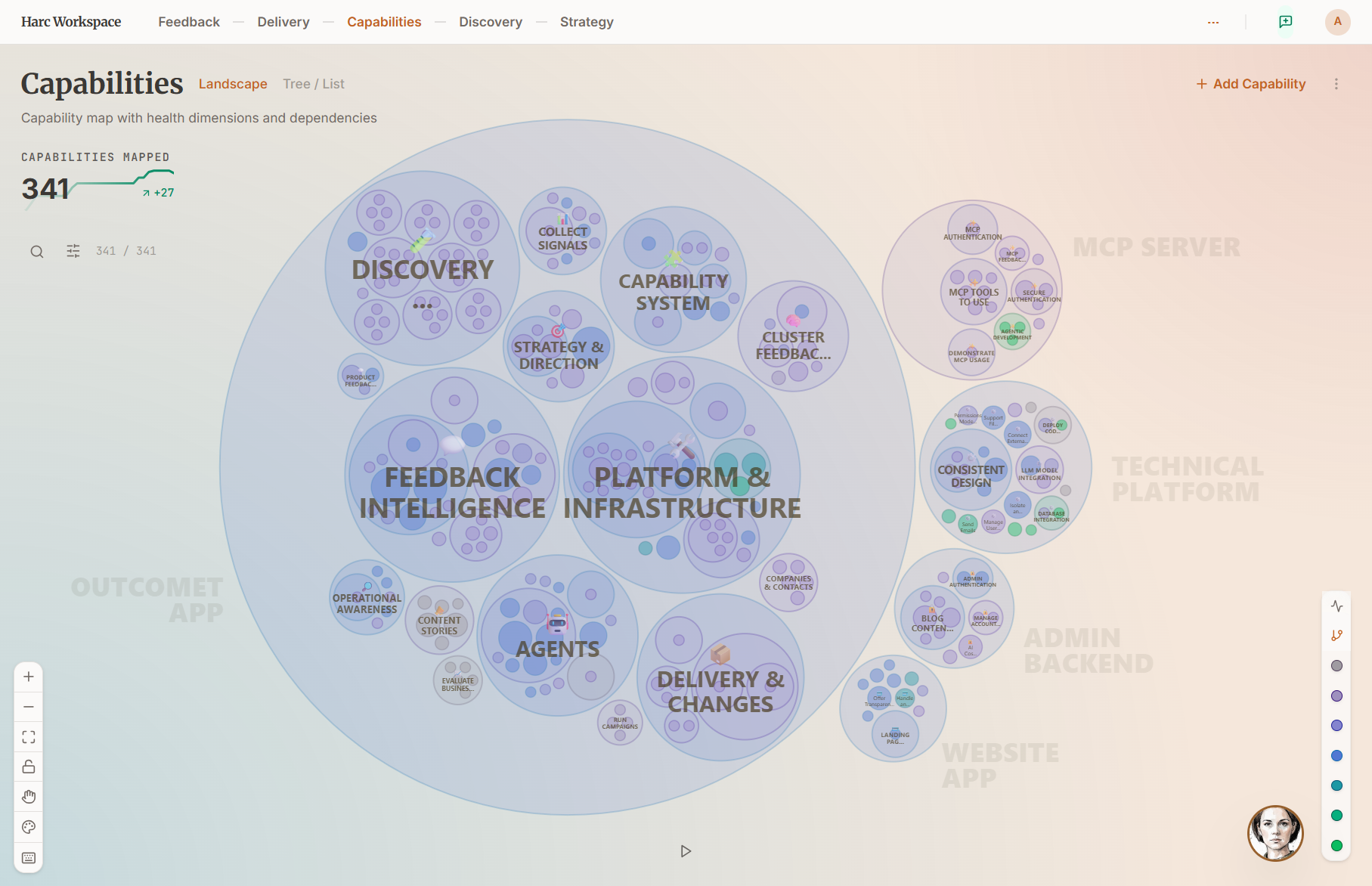
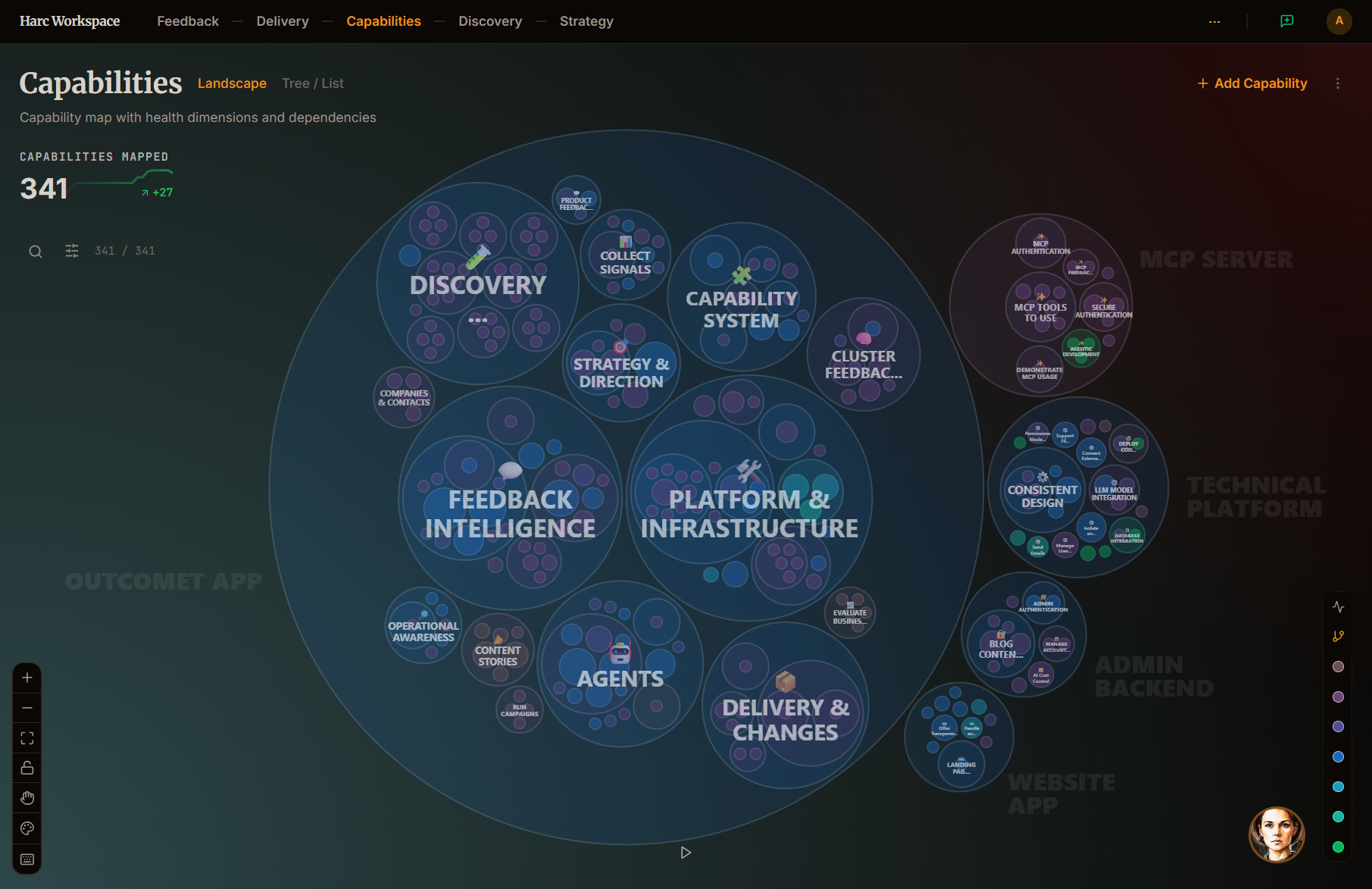
Open the map at full size in a new tab
What does our product do now, and why did it change?
Open any capability to see the customer feedback, the decision and the pull requests behind it.
Which feature should we build next?
Collects feedback from many sources, scores features with your own formulas, and shares plans through roadmaps and a customer portal.
Compare the jobs each tool handles
| Feature | Outcomet | Productboard |
|---|---|---|
| Core job | Keep an up-to-date map of what your product does, with the feedback and decisions behind each part | Collect feedback, prioritize features, publish roadmaps |
| Product structure | A capability map that changes when your product changes | Products, components, features and subfeatures that your team maintains |
| When a pull request comes in | Outcomet summarizes the change and suggests capability updates for you to accept or reject | Nothing updates on its own. A coding agent can edit a spec or move a status through Productboard's MCP server when asked. Codebase analysis is documented as read-only |
| Decisions | Each decision is a record with its evidence and its history | Priorities through custom scoring formulas and objectives |
| Feedback intake | Email, direct capture and MCP | Many sources, including Zendesk, Intercom, Gong, Slack, G2 and a voting portal |
| AI | Nova proposes problems next to the original words, and you approve them | Spark summarizes feedback, writes specs and evaluates launches |
Productboard information from pricing, Spark, integrations, codebase analysis and coding agents via MCP, reviewed 25 September 2026. Features depend on the plan.
The part that goes out of date
A feature list is only as current as the last person who updated it. In Outcomet, the work that ships comes back into the map, so nobody has to remember to update it.
Choose Productboard if you need
- A public portal where customers vote on ideas
- Feedback connectors for Gong, Intercom, G2 and app stores
- SOC 2 and ISO certificates on the buying checklist
- A free plan to start with
Choose Outcomet if
- Your feature list no longer matches the product
- Nobody can say why a shipped feature was built
- You want what shipped to update the picture automatically
- Decisions should stay readable after the person who made them has left
I rolled out Productboard at three companies. Here is how it compares