I Became Obsessed With My Changelog. And It Changed How I Think About Product Work.


It started with something small.
I shipped a feature and wanted to write a clean changelog entry for it. Not just a quick note, but something that actually explains what changed in a way a user would understand.
So I refined it.
Then refined it again.
Then I started adjusting the process behind it.
At some point, I realized something slightly uncomfortable.
I was spending more time improving how the changelog gets written than building the feature itself.
That’s when it hit me.
I wasn’t optimizing my product. I was optimizing the system that explains it.
And that turned out to be far more interesting than I expected.
The hidden problem with how we document product work
Most product teams treat the changelog as an afterthought.
It usually looks like this:
- a list of tickets
- a copy of commit messages
- or a quick summary written under time pressure
The result is predictable. The changelog becomes a technical artifact instead of a product artifact.
At the same time, the actual product management process is fragmented:
- product strategy lives in slides
- product discovery happens in documents
- delivery is tracked in tickets
- product feedback sits in support tools
Each part exists. But the connection between them is weak.
And because of that, something important gets lost.
The story.
How product work actually happens
If you look closely, product work is not a list of tasks.
It is a system.
A continuous loop that connects thinking, building, and learning:
- product strategy defines direction
- product discovery explores opportunities
- delivery turns ideas into capabilities
- product feedback reshapes understanding
This loop is where real product progress happens.
But most tools are still built around the product backlog. A static list of work items that tries to represent a dynamic system.
The backlog captures intent.
But it does not capture what actually happened.
What we lose when we focus on the backlog
The backlog is useful for planning. But it has a structural limitation.
It is future-oriented.
It tells you what you might build.
But it says very little about what you actually learned.
And over time, this creates a gap.
You lose the connection between:
- why something was built
- what changed in the product
- what users experienced
- what the outcome actually was
The product management process becomes harder to understand, even for the team building it.
You are constantly moving forward, but the past becomes blurry.
The strange system I ended up building
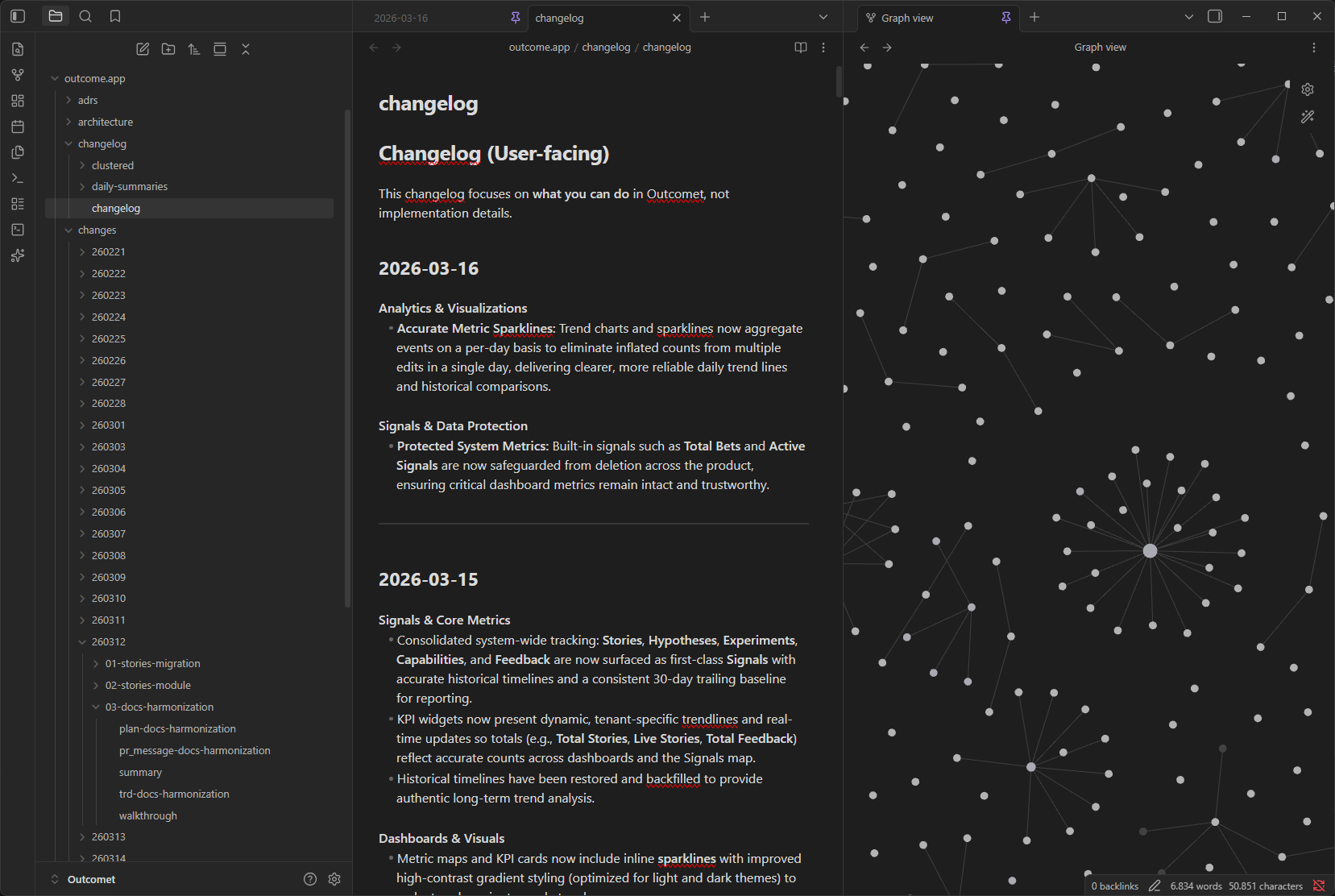
Instead of writing changelog entries manually, I started structuring the process behind them.
For every change, I create a small working context. A folder that captures everything related to that specific modification.
Inside it:
- a plan
- a knowledge file
- a technical change description
- a PR message
- and a summary
The summary became the central artifact.
Not the code. Not the ticket. The summary.
From there, I built a small pipeline.
Each change is summarized first. Then all summaries of a day are collected. Those summaries are grouped and rewritten in user language. Only at the end is the actual changelog entry created.
The changelog is not written. It is assembled.
Each day becomes a small narrative of what changed in the product.
Not a dump of commits. Not a list of tickets.
A story.
 ---
---
A small detail that changed everything
One design decision made this system practical.
Only the current day is ever regenerated.
Everything else stays fixed.
This has a few important effects:
- the system remains predictable
- AI costs stay under control
- past entries become stable artifacts
And something else happens.
The changelog starts to grow into a structured history of the product.
Not a documentation layer.
A memory.
The shift from backlog to history
What surprised me most was the side effect this created.
The backlog slowly stopped being the most important artifact.
Not because planning became irrelevant.
But because the history of what actually shipped became more valuable than the list of things we might build next.
The changelog became a reflection of reality.
It shows:
- what changed
- how it changed
- and how the product evolved over time
In a way, it became closer to the actual product management process than the backlog ever was.
A new mental model for product work
Building with AI changes the dynamics of product development.
Features that used to take days now take minutes.
That shifts the bottleneck.
It is no longer about writing code.
It is about understanding, structuring, and communicating what is happening.
When building becomes fast, structure becomes the real work.
The changelog is one of the few places where all parts of the system come together:
- strategy becomes visible through decisions
- discovery becomes visible through changes
- delivery becomes visible through outcomes
- feedback becomes visible through iteration
It connects the loop.
What this might mean for the future of product management
If you take this idea further, it challenges a common assumption.
Maybe the product backlog should not be the central artifact of product management.
Maybe it should be something else.
A system that captures:
- what changed
- why it changed
- and what was learned
A system that reflects the product as it evolves, not just as it is planned.
Something closer to a product operating system than a task list.
Closing thought
I did not set out to redesign how I think about product work.
I just wanted to write a better changelog.
But along the way, something shifted.
The changelog stopped being documentation.
It became the place where the product tells its own story.
And once you see it that way, it is hard to go back.
Related Posts
Your Coding Agent Has the Ticket. It Doesn't Have the Customer.
I let an agent run for ten hours on one feature, off a PRD I had polished for days. It came back technically integrated and no user could operate it. The spec had the what. The why was sitting somewhere else, and the agent had no way to read it. Outcomet's MCP connection changes that.
August 2026: Say What You Mean
Outcomet ships a review path for agent-proposed capability changes, GitHub issues as first-class Work Items, and MCP connections that survive a server restart.
The Five Meters Back
A few weeks ago I gave in and built a Jira integration into the product I am building. I did not want it there. It points backwards, into the way of working I think is ending. For a while I filed that work under waste, until I heard what I was actually claiming: my thing is right, so the market should do the walking.